Applied NLP · Reddit Discourse · Software Updates

When the OP disagrees with the crowd: discourse classification & sentiment divergence in software-update threads

Software-update discussions on Reddit are not monolithic — they split into Technical Problem-Solving (TPS) and General Discontent (GDS). We show this split is learnable from text, and that it correlates with how the emotional gap between the original poster and the community evolves over the thread. Title-level sentiment alone is not enough; thread structure matters.

542
expert-labeled Reddit posts (benchmark corpus)
86 / 456
TPS / GDS class split (real-world imbalance)
3,519
update-related threads collected via ReleaseTrain API
324
high-engagement trajectory cohort (role-separated streams)
p = 0.006
TPS vs GDS divergence association (Mann–Whitney)

The Research

Two kinds of conversations hide inside “update broke my stuff”

Every software release triggers a wave of Reddit threads. Some are constructive debugging sessions; others are venting. We formalize this as a binary discourse classification task and study how author and community emotions diverge in each.

TPS

Technical Problem-Solving

Threads centered on a concrete technical issue: reproduction steps, logs, version pinning, workarounds, and resolution. The OP typically starts neutral-to-negative and the community converges on a fix. Example flavor: “After updating to 6.8, my Wi-Fi driver fails to load — here’s dmesg.”

GDS

General Discontent

Threads dominated by frustration, opinion, or meta-complaints about a product or vendor rather than a solvable defect. Emotional language, fewer actionable details, pile-on dynamics. Example flavor: “This update is the worst thing they’ve ever shipped. Who approved this UI?”

RQ1 · ClassificationIs TPS vs GDS learnable from full-thread text? Supervised models (classical vs transformer) under real class imbalance, with imbalance-aware metrics.
RQ2 · DivergenceDo TPS and GDS threads diverge differently? Is the OP more negative than the community more often in one discourse type than the other?
RQ3 · TrajectoriesDo sentiment trajectories carry signal? Role-separated, time-ordered author vs community sentiment curves: slope, volatility, early-vs-late shift.
RQ4 · GeneralizationDoes it hold across subreddits? Robustness on a software/dev-only subreddit tier, and failure modes of lexicon (VADER) baselines.

Key Finding

In problem-solving threads, the author is the unhappy one

Across the 542 labeled threads, the original poster is more negative than their community far more often in TPS threads than in GDS threads — the person with the broken system is more frustrated than the crowd helping them, while in discontent threads the crowd matches the OP’s mood.

TPS author more negative than community 69.8%
GDS author more negative than community 53.7%
+16.0 pts
rate difference (TPS − GDS)
[0.051, 0.269]
bootstrap 95% CI
p = 0.006
Mann–Whitney U
d = 0.33
Cohen’s d, |author − community| divergence

Robustness: restricting to a software/dev/platform subreddit allowlist (Tier-A, n≈304) the effect persists — Δ = 0.105, Mann–Whitney p = 0.0125. Author mean sentiment is also markedly lower in TPS (0.01 vs 0.19, d = −0.50, p < 0.001), while community mean sentiment barely differs — the divergence comes from the author’s side.
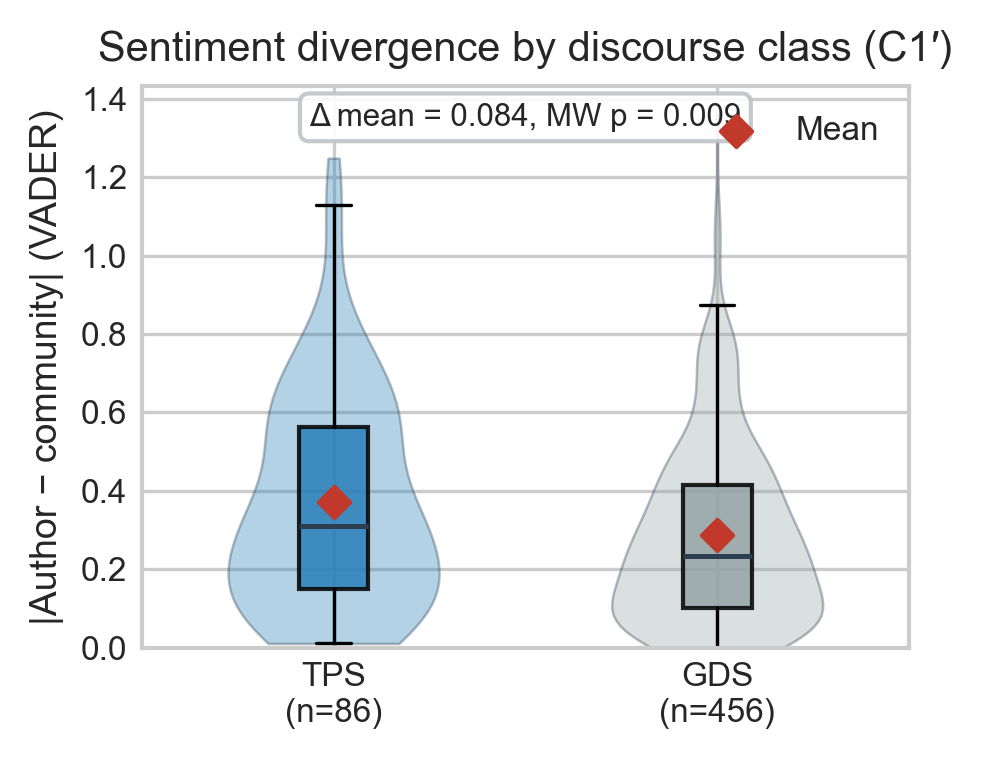
Violin plot of author–community sentiment divergence by discourse class
Distribution of |author − community| mean-sentiment divergence per thread, split by discourse class. TPS threads show systematically larger divergence. Click to enlarge.

Model Benchmark

TPS vs GDS is learnable — and classical baselines are honest competition

Same pipeline for all models: 542 verified labels, GDS undersampled to 175 with all 86 TPS kept (261 rows), stratified 70/15/15 split. We report imbalance-aware metrics on the held-out test set.

ModelTest acc.F1 (TPS)F1 (macro)Recall (TPS)
Naive Bayes · TF-IDF0.7000.5710.6700.615
BERT · fine-tuned, weighted CE0.6500.5630.6350.692
VADER rule · technical-first0.5000.5450.4950.923

TF-IDF + Naive Bayes leads on accuracy and macro-F1 in this run; fine-tuned BERT is second. The VADER rule baseline catches nearly all TPS threads (recall 0.92) but floods them with false positives (precision 0.39) — exactly the lexicon failure mode RQ4 documents. 5-fold CV and Tier-A robustness checks preserve the ordering (NB macro-F1 0.659 full → 0.703 Tier-A).

Trajectory Explorer

Watch author and community sentiment evolve, thread by thread

Each thread is split into two role-separated streams — the author (opening post + every OP comment) and the community (everyone else) — scored per event with VADER and ordered in time. Below: the top-10 threads by comment volume from two ReleaseTrain cohorts. Hover any line for the post, subreddit, and exact score.

solid = author stream (per-thread) dashed = community stream (per-thread) thick orange = mean author (10 threads) thick blue = mean community (10 threads)

Per-thread, comment-index view of the same role-separated design: orange = author stream, blue dashed = community stream, x-axis = chronological comment number. Click any chart to enlarge.

Live Demo

The pipeline, running in your browser right now

These panels fetch fresh Reddit slices from the ReleaseTrain API on every load and run VADER sentiment scoring client-side — the same role-separated trajectory construction used in the paper, applied to whatever the community is discussing today.

Live multi-subreddit trajectories

Loading ReleaseTrain data and VADER…

Three merged API slices (engagement pool, minScore ≥ 0.5, maxScore ≤ 0.5; up to 500 posts each), top 5 per subreddit by comment count. One chart per thread: VADER compound vs chronological comment index. Click a point or the header link to open the Reddit thread.

Any subreddit — balanced score cohorts

Loading subreddit list and class slices…

Up to 6 charts per subreddit: up to 3 from the minScore ≥ 0.5 cohort and 3 from maxScore ≤ 0.5 (minComments = 3, 500 rows each). The dropdown lists every subreddit in the ReleaseTrain meta index — some have no rows in the current sample; pick another or refresh.

Dataset & Methods

A documented, reproducible benchmark

The corpus, annotation protocol, and evaluation pipeline are fully documented so results can be reproduced end-to-end from the public ReleaseTrain API.

Corpus 542 unique software-update Reddit posts with expert-corrected TPS/GDS labels (86 / 456). Full-thread text construction: title + body + all comments, with API provenance.
DATA_CARD.md
Annotation guidelines Operational definitions, decision rules, and edge-case handling for the TPS/GDS distinction, designed for replication and inter-annotator agreement studies.
ANNOTATION_GUIDELINES.md
Trajectory cohort 324 high-engagement threads (≥3 author replies, ≥5 community comments) with role-separated, time-ordered sentiment streams and derived statistics (slope, volatility, early–late shift).
data/enhanced_automated_sentiment_results.json
Evaluation protocol Stratified splits and 5-fold CV, imbalance-aware metrics, ablations (title-only vs full thread vs + trajectory features), error analysis, and Tier-A subreddit robustness checks.
evaluation/ · analysis/outputs/
Data source All threads collected through the ReleaseTrain update-intelligence API (releasetrain.io/api/reddit) — used strictly as a data source.
Human validation Manual sentiment-trajectory review templates and a human-validation pass comparing VADER trajectories against annotator judgments on sampled threads.
documentation/HUMAN_VALIDATION_GUIDE.md